Owning my news feed, the AI gap, and _AI psychosis (?)_
My latest hobby is building news accounts on social media that run themselves, 24/7, and are tailored to what I want to read.
Two of them are @startupsinasia and @warnetnews.
They run on my own AI agent, built on Claude Code (claude-code-discord) and running 24/7 on an exe.dev VM. Each project has its own Discord server, where the agent and I talk to each other, just like I usually work with human teammates on Slack.
Each account does the whole job by itself. It researches what to post, designs the post, publishes it to Instagram, TikTok, Threads and more, and sends me an analytics report every week. I set each one up once. If a result looks off, I just tell the agent in that project’s Discord server, and these days that rarely happens.
The rules are simple, and they’re mine: no clickbait, clear headlines, just the news.
Who gets to tell the news
Watching these accounts run made me think about how power in the news has shifted:
- First, only big media could publish. If you wanted to reach the public, you needed a newspaper, a TV station or a radio license.
- Then social media gave everyone a microphone. With Twitter and the rest, anyone could break a story.
- Then the algorithm took over. Feeds got tuned for engagement instead of usefulness, and a lot of what we scroll now is bait.
I think we’re entering a fourth era: AI is handing the power back to the consumer. Anyone with a decent AI setup can build their own news feed around their own preferences, with no outrage-tuned algorithm in the middle. It’s surprisingly easy to do, whether with a custom setup like mine (claude-code-discord) or with AI assistants like Hermes Agent.
I really like this era.
But not everyone uses it that way
To be fair, a lot of people with AI agents are doing the opposite. They’re mass-producing brainrot: AI slop videos, fake stories, recycled engagement bait, posted 24/7 just to farm views.
Same tools, opposite outcome.
So AI doesn’t fix the feed by itself. It just gives the power to whoever’s holding it. You can use it to build a feed that respects your attention, or to build a machine that steals everyone else’s.
I’m trying to be on the right side of that ://
Daring to dream (maybe a little too much)
This goes way beyond social media. AI today, at least as of Opus 5.5, can help almost anyone do almost any kind of digital work. That has made me dream bigger and get more ambitious. It may also have made me a bit delusional about how many things I can do at once, and how fast.
Some people call this “AI psychosis.” The term always reminds me of cyberpsychosis in Cyberpunk lore. Edgerunners who load their bodies with too much chrome risk losing their minds. Maybe people with 24/7 access to the most powerful AI models carry a similar risk, and AI psychosis is an early, softer form of cyberpsychosis (hehe, ofc it’s a joke).
Most people haven’t seen it yet
Very few people know what it’s like to run a frontier AI model nonstop on a computer that never sleeps. Andrej Karpathy put it well:
“Dusting off this tweet from April because this gap in shared understanding of LLM capability is widening. It’s now less “two groups of people speaking past each other” and more a sharp funnel.”
He estimates that about 6 billion people have barely touched LLMs at all, and that another 1 to 2 billion are casual users who “see derpy chatbots and treat them a bit like a better Google search.” Then there’s a much smaller group:
“Somewhere around 20M people (0.2%) see first-hand that large, complex projects that used to take them weeks/months can now be completed by agents with a prompt.”
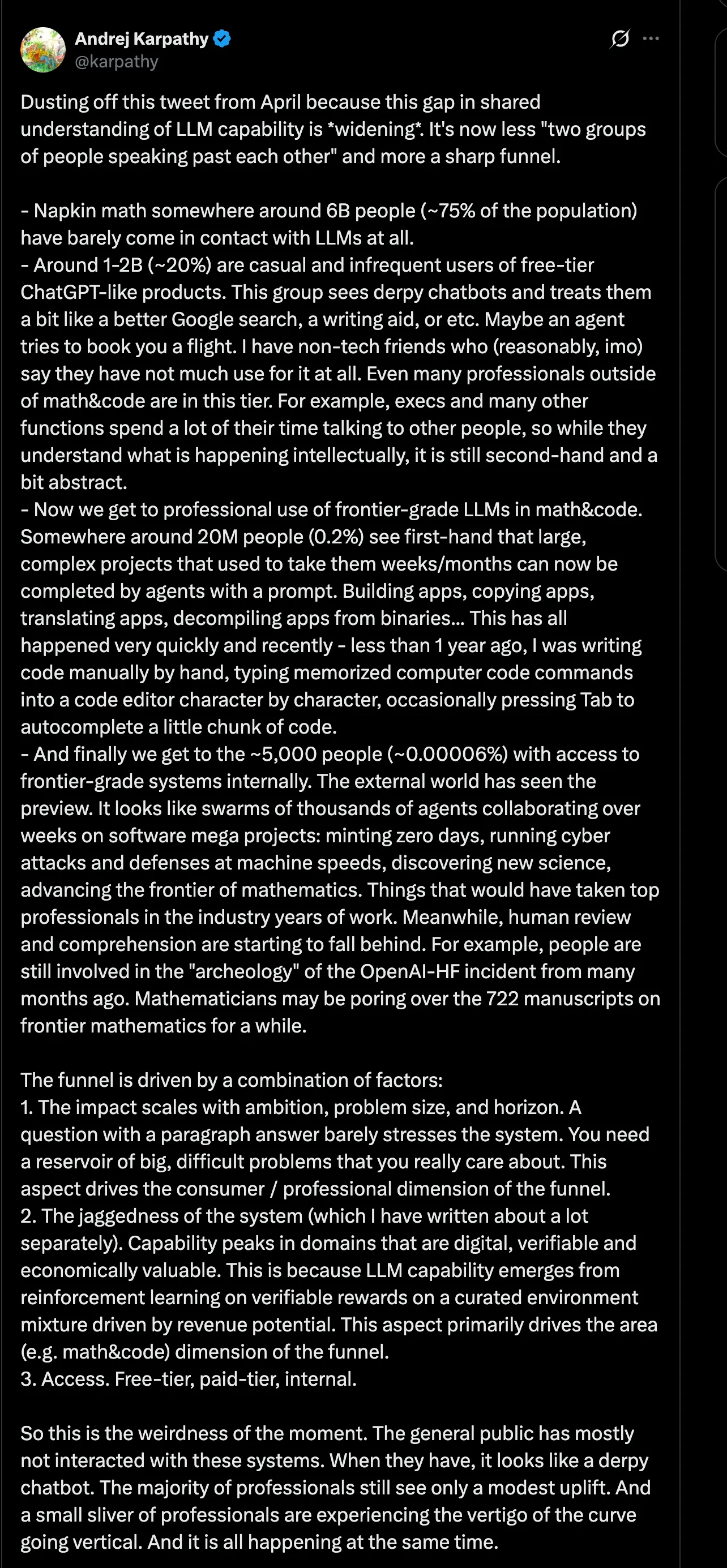
I think that gap is why so few people are paying attention yet.
Most people only see the slop side, which might be part of why the gap is so wide.
The part that worries me
Empowering consumers is only half the story. The same capability that lets me run news accounts by myself can also replace whole teams. We’re in the middle of another industrial revolution, and the layoffs keep coming.
Governments need to act now to protect workers, before most people even realize what today’s AI agents can do. Once awareness catches up with capability, change will come fast, and our safety nets aren’t ready.
I love this era. I just want it to be good for more than the 0.2% who can already see it.
Enjoyed this article?
Get future posts delivered to your inbox so you never miss one. You can also follow via RSS feed.
Subscribe via email